
SS&C Advent (Geneva, Moxy, Genesis, APX) - Competitors & Alternatives
SS&C Advent is a long-established investment management software provider within the SS&C Technologies ecosystem, offering a suite of solutions including Geneva, Moxy, APX and Advent Genesis to support portfolio accounting, order management, trading and operational control across buy-side firms. Widely adopted by asset managers, hedge funds and institutional investors, Advent’s product family spans front, middle and back office workflows. As investment technology expectations shift towards cloud native architecture, real time data consolidation and integrated front-to-back platforms, many firms are evaluating SS&C Advent alternatives to determine whether a unified modern investment management system offers greater operational agility, transparency and long-term scalability.
Note: Vendor information here is based on company websites, industry publications and online review sites such as G2, Gartner, TrustRadius and Capterra. Such pages have been reviewed in March 2026 as a basis for this article.
Why clients opt for Limina


Managed upgrades that adhere to highest governance requirements of large managers. Become nimble through quick release cycles and self-service features.
What clients are saying
By adopting Limina's scalable platform, Avanza has launched 33% additional funds without having to scale its investment operations team. They achieved:
- Decreased dependency on single individuals - by replacing spreadsheets
- Improved operational efficiency - by increased automation
- "It’s such a modern portfolio management system – not only because it’s cloud-based, but the entire process flow and information I get is complete and up to date. It’s simple to use, flexible to work with, and it minimises the time for the entire trade workflow." / Portfolio Manager
- "Limina helps us reduce operational risks." / CEO
What makes Limina different?
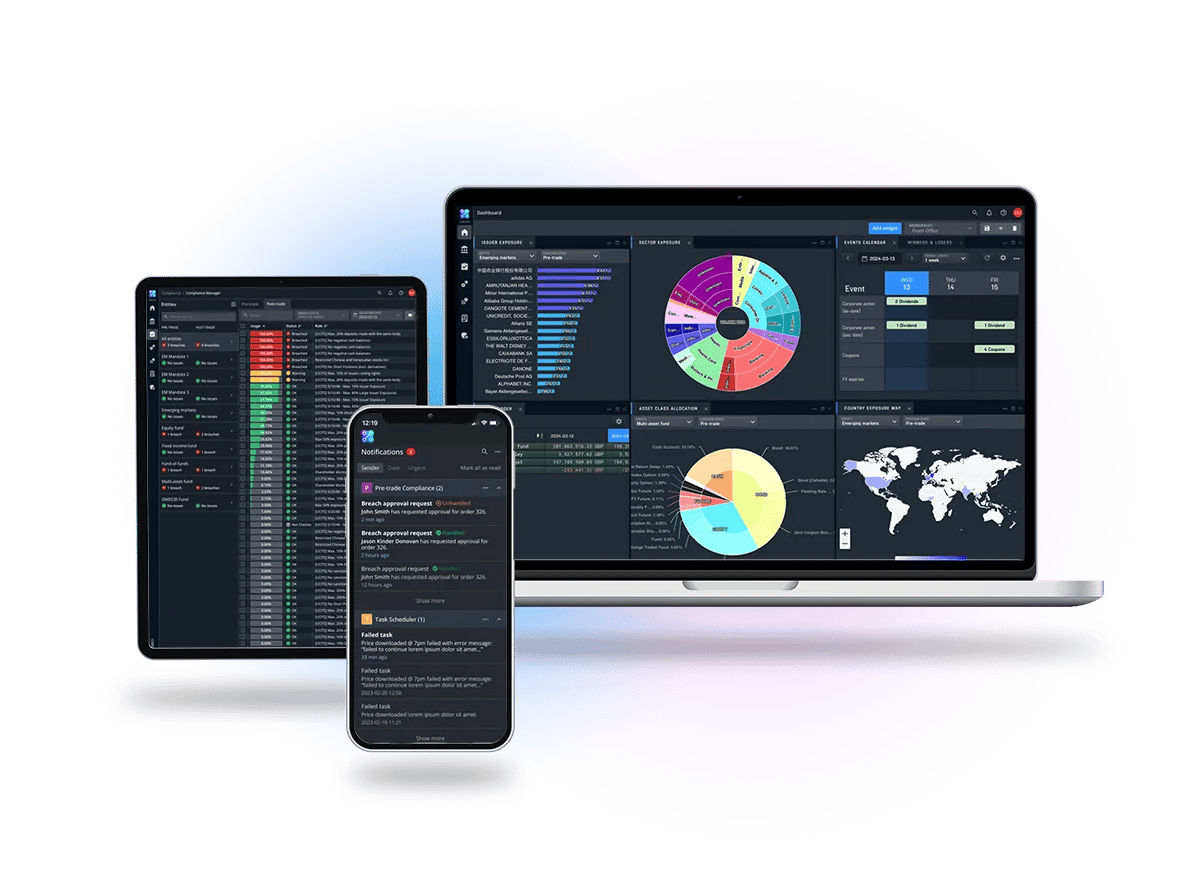
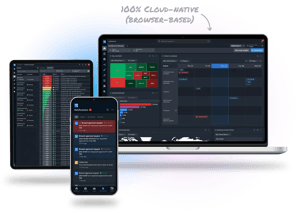
Modern user experience
- Full-feature access from browser and tablet
- Native mobile app
- Slick & efficient workflows
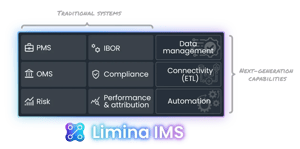
All workflows & assets in one system
All the workflows you need - combined in one solution with powerful automation capabilities & built-in data controls.
All asset classes supported, including funds, alternatives, FX (and everything else)
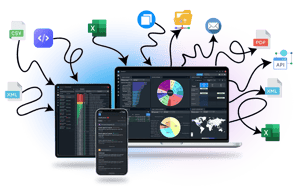
Connect to anyone. Create any report
Greatly reduce the time spent on manual data input and extracts with Limina's powerful connectivity:
- Standard connectivity to the most popular data & service providers
- Easily build, schedule and maintain your own custom integrations & reports - in minutes without technical expertise
Self-service
Don't be held back by waiting for your vendor. Take control and get empowered to configure by yourself in minutes:
- Integrations & connectivity
- Compliance rules
- Custom classifications (e.g. ESG and risk classifications on securities)

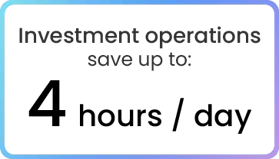
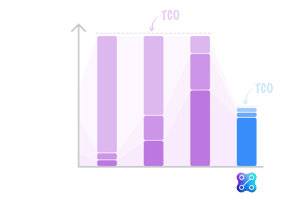
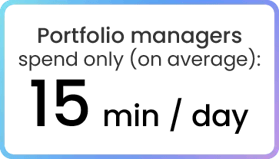
Efficient processes = Save money
See the next market leader in action
If you're looking to get ahead, and stay ahead, why not schedule a no obligation demo with us at a time to suit you?SS&C Advent: Product Suite Structure, Architecture and Strategic Fit
SS&C Advent is a long-established investment management software provider within the SS&C Technologies ecosystem, offering a portfolio of solutions including Geneva, Moxy, APX and Advent Genesis. Rather than a single unified platform, Advent operates as a suite of systems supporting portfolio accounting, order management, trading, reporting and operational control across hedge funds, asset managers and institutional investors.
Geneva is widely used for complex fund accounting, Moxy provides order management and execution workflows, APX supports portfolio accounting and reporting, and Advent Genesis functions as an integration and workflow framework connecting data across modules. Collectively, these products form a broad operational toolkit for buy-side firms.
When evaluating an SS&C Advent alternative, the central question is not only functional capability, but how effectively a multi-product suite delivers data cohesion, workflow alignment and long-term architectural flexibility across the investment lifecycle.
- 01 Product Ecosystem
- 02 Architecture & Deployment
- 03 Implementation & Governance
- 04 Data & Oversight
- 05 Integration & Ecosystem
- 06 Organisational Fit
- 07 Summary
Geneva, Moxy, APX and Genesis in Context
A defining characteristic of SS&C Advent is its modular product architecture. Firms may deploy Geneva for complex fund accounting, Moxy for order management and execution control, APX for portfolio reporting and accounting, and Advent Genesis to orchestrate data exchange and workflow integration across systems. This suite-based structure allows organisations to align specific products with distinct operational responsibilities.
For firms with clearly segmented teams and established system ownership, this flexibility can provide targeted depth within each functional area. However, where multiple Advent modules operate in parallel, careful governance is required to ensure positions, cash balances, exposures and performance data remain consistently aligned across accounting, trading and reporting layers. Data synchronisation processes, reconciliation workflows and integration oversight can become embedded components of the operating model.
When evaluating an SS&C Advent alternative, many firms assess whether a unified investment management system built on a single data architecture can reduce cross-system complexity and reconciliation overhead. Platforms designed around a consolidated and cloud native architecture, are structured to maintain consistent data integrity across workflows without layered integration dependencies.
Suite Integration Versus Unified Platform Design
SS&C Advent solutions have historically been delivered through a combination of licensed, hosted and managed service models, reflecting the lineage of individual products. While SS&C continues to modernise its delivery approach, the architecture remains product-centric rather than natively unified.
Where Geneva, Moxy and APX coexist, data flow and upgrade coordination require structured governance. Advent Genesis is designed to harmonise workflows and data exchange, yet the overall cohesion of the environment depends on implementation design and ongoing integration management.
When evaluating an SS&C Advent alternative, architectural considerations become central:
-
Is the platform built on a single codebase or multiple integrated systems?
-
How are upgrades coordinated across modules?
-
How is data normalised across trading, accounting and reporting workflows?
Modern cloud native platforms architected as a single, unified environment typically operate on continuous deployment models with centrally managed upgrades. Built around a consolidated codebase rather than multiple integrated products, they reduce dependency on coordinated release cycles and layered integration frameworks. This architectural approach, reflected in Limina’s unified platform design, can materially influence long-term operational complexity, upgrade governance and total cost of ownership.
Coordinating Multi-Product Environments Over Time
Implementing SS&C Advent often involves configuring and integrating multiple products, such as Geneva, Moxy and APX, across distinct operational teams. While this modular approach allows firms to tailor functionality to specific workflows, it can also introduce layered project governance, phased rollouts and cross-system data migration requirements.
Where accounting, trading and reporting components are deployed separately, implementation scope may extend beyond software configuration into integration design, data mapping and reconciliation planning. Advent Genesis can support orchestration across systems, yet long-term cohesion depends on how effectively integrations are architected and maintained.
Upgrade management forms part of this operational equation. In multi-product environments, release cycles and enhancement timelines may need to be coordinated across modules, requiring structured testing, regression validation and internal change control processes. For firms operating under formal governance frameworks, this coordination may be expected. However, it also increases the importance of internal resourcing and ongoing oversight.
Implementation complexity and long-term coordination overhead often become decisive factors in platform selection. Unified cloud native architectures reduce these pressures by operating on continuous deployment models with centrally managed upgrades rather than coordinated cross-product release cycles. A clearly defined implementation process further supports predictable time to value and minimises operational disruption as the platform evolves.
The distinction often lies not in feature breadth, but in how sustainably the system evolves over time without expanding internal governance burden.
Accounting Depth and Cross-Workflow Visibility
Geneva and APX remain recognised accounting engines within the Advent ecosystem, particularly for firms with complex fund structures, multi-currency mandates and intricate reporting requirements.
However, where execution (Moxy), accounting (Geneva or APX) and reporting layers operate as interconnected, yet distinct systems, data synchronisation and exception handling must be carefully managed. Batch alignment processes, integration scripts and reconciliation workflows can become embedded into daily operations.
The structural distinction typically emerges in how trading, portfolio modelling and accounting data are aligned across the investment lifecycle. Environments built on a single, consolidated data foundation allow positions and exposures to remain synchronised as activity moves from execution through to oversight. For firms prioritising transparency and faster decision cycles, the ability to maintain continuous data integrity across workflows has become increasingly important.
SS&C Ecosystem Consolidation Versus Architectural Independence
SS&C Advent operates within the broader SS&C Technologies ecosystem, which spans fund administration, middle-office services and additional investment software solutions. For firms already embedded within SS&C’s vendor footprint, consolidation under a single provider may simplify procurement and commercial alignment.
At the same time, investment technology strategy increasingly favours open APIs, modular connectivity and the ability to integrate custodians, brokers and specialist analytics providers without tight dependency on a single vendor stack. Limina’s platform connectivity framework illustrates how structured API governance and native data normalisation can support extensibility without introducing layered integration complexity.
When assessing SS&C Advent competitors, integration flexibility and roadmap transparency often carry as much weight as individual module functionality.
Operational Scale, Complexity and Product Strategy
SS&C Advent solutions are particularly suited to firms with established operational teams, formalised governance processes and the internal resources required to manage a multi-product ecosystem. Hedge funds leveraging Geneva’s accounting depth or asset managers standardised on APX reporting may find Advent aligned with their historical operating model.
Not every organisation requires a multi-product suite spanning separate accounting and trading systems. For some firms, reducing administrative coordination, upgrade planning and cross-system oversight becomes a strategic priority. Architectural models built around unified design and centrally managed release cycles, can limit internal coordination demands and simplify long-term system evolution.
The appropriate fit ultimately depends on your organisational structure, growth trajectory, asset class coverage and tolerance for cross-system architectural management.
Evaluating SS&C Advent in Today’s Investment Technology Landscape
SS&C Advent represents a mature and widely adopted investment software ecosystem. Geneva, Moxy, APX and Genesis collectively support trading, accounting, reporting and operational control across buy-side firms with complex requirements. Its modular design and accounting depth continue to make it relevant within institutional environments.
Yet as expectations shift towards cloud native deployment, unified data architecture and automated front-to-back workflows, many firms are re-examining whether a multi-product suite remains optimal. When comparing SS&C Advent with modern investment management systems, the most meaningful distinctions often relate to architectural cohesion, data consolidation, integration governance and long-term operational simplicity rather than isolated feature depth.
A structured evaluation of suite integration, deployment governance and workflow alignment will determine whether SS&C Advent supports your long-term strategic objectives or whether a unified, cloud native investment management system provides greater agility, transparency and scalability.